
INTERNAL TOOLS •UX STRATEGY •B2B TOOL
Aligning global teams with
a clear view of priorities
INTRODUCTION
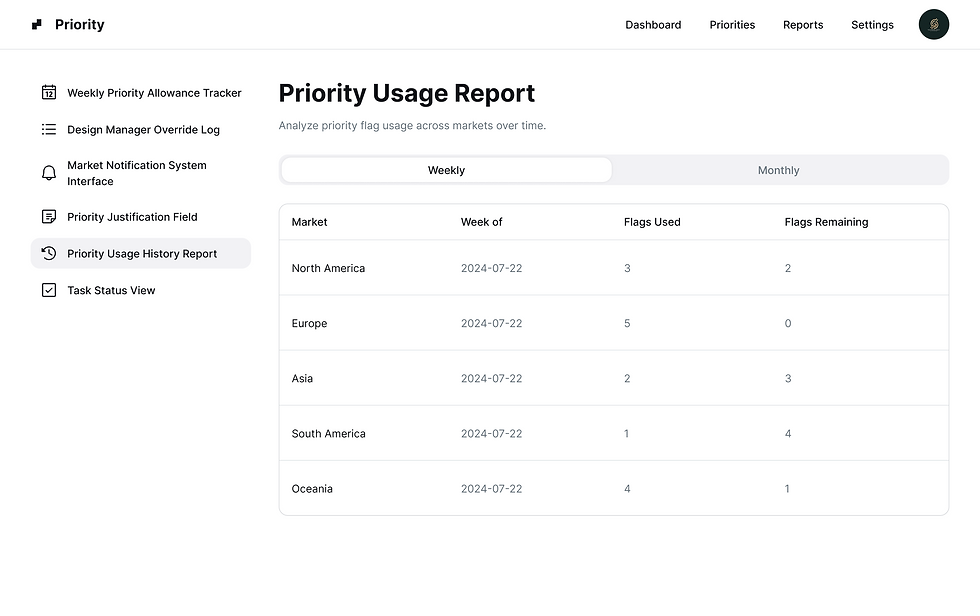
The Priority app is an internal decision-support tool designed to bring transparency and structure to how global project requests are assessed and prioritised. Built to serve regional stakeholders and central teams, it enables clearer communication of demand, faster evaluation of business impact, and stronger alignment around shared strategic goals.
This case study covers the transformation from fragmented spreadsheets and inconsistent processes into a unified, scalable tool.
Role
Lead UX
Timeline
January 2022 - February 2022 (6 weeks)
Tools
Figma,FigJam, Miro, Jira, Excel
.png)
PROBLEM STATEMENT
While working as a design manager at Industry Dive, our clients had a global presence and therefore we had multiple teams responsible for different group of countries. Each global team, submitted project requests independently, via Jira and adding comments or sending separate e-mails in regards to multiple priorities. As one of the members of the central management teams we often found ourselves overwhelmed, with limited visibility into the rationale behind each request, making it difficult to identify trends, compare urgency, or align freelance work to business demands.
We needed a way to:
-
Standardise project intake
-
Provide transparent prioritisation logic
-
Give both local and central teams a shared source of truth
MY ROLE
Since I was a design manager myself at the time, and could really feel the fustration and the lack of flexibility that Jira could give us I decided to step forward and using my previous product design experience suggest an internal tool that could handle these requests while making them visible to all interested departments.
I led the UX strategy and design for the tool, partnering with a program manager, various strategists, and stakeholders across commercial, operational, and regional teams.
My responsibilities included:
-
Running discovery with country managers and central teams
-
Mapping the end-to-end prioritisation workflow
-
Designing a scalable interface and data structure
-
Testing prototypes and gathering iterative feedback
PROCESS
I began by mapping current-state pain points and identifying patterns in how countries submitted project asks and priorities.
Through collaborative discovery, I:
-
Interviewed regional leads and ops managers to understand their workflows and define our personas
-
Analysed historical project requests to uncover inconsistencies and overlaps
-
Defined common prioritisation criteria used across teams (e.g. customer impact, revenue potential, operational risk)
I then created some early concepts and tested them with a small group of internal users/ shareholders.


THE SOLUTION
The final product was a lightweight internal tool that allowed countries to submit project requests via a structured form and
view a shared prioritisation dashboard.
Key features included:
-
For the Intake form we standardised inputs for country, project type, estimated effort, expected outcomes
-
Automated weighting based on predefined business impact criteria
-
Created visual prioritisation board, filtered by country, theme, or timeframe
-
Added Comments & statuses as well as ability to track decisions, feedback, and progress
These features made it easier for regional users to advocate for their needs and easier for central management teams
to plan with confidence.
IMPACT
The tool delivered measurable improvements in visibility and alignment:
-
20% reduction in duplicated or overlapping project asks
-
Faster decision-making in quarterly planning cycles
-
Clearer rationale shared with country teams, reducing back-and-forth
-
Increased satisfaction among both submitters and reviewers
It also supported a shift from reactive delivery to proactive, strategic planning.
LEARNINGS
This project reinforced the importance of designing internal tools with the same attention and care as external products, teaching me to balance flexibility with consistency by making structured forms feel adaptable, design intuitive experiences for non-technical users while still surfacing complex logic, and enable collaboration across siloed functions through shared visibility.
Most importantly, I recognised a gap in our internal processes and took the initiative to propose and design a lightweight tool that delivered real value. Even in my role as a design manager, I was able to draw on past experience to lead this effort, proving that strategic thinking and proactive advocacy can make a meaningful difference regardless if it is for an internal team or external users.
And it was that project that ignited my passion for building software and made me to deside to go back to a more hands-on, product designer role.
OTHER PROJECTS

Building a geopolitical AI tool with custom agents