OTHER PROJECTS

Building a geopolitical AI tool with custom agents
Turning billing complexity into a dynamic dashboard
•AI SENSE MAKING •AI DESIGN PATTERNS •COMPLEX SYSTEMS
From search to insight.
Re-imagining AI workflows that
turn data into action
INTRODUCTION
Vantage is a B2B AI platform designed to help users explore complex curated datasets and uncover meaningful insights. We had already invested in improving onboarding, navigation, and core usability. Users could find their way around the product and access relevant information, but something fundamental was still missing.
The platform helped users search and explore, but it did not yet help them deliver outcomes. This case study focuses on how we redesigned the end to end workflow to move users from discovery to insight to tangible output, turning Vantage from a data exploration tool into a decision support platform.
Role
Sole Senior Product Designer
Timeline
September 2024 - February 2025
Tools
Figma,FigJam, Jira, UserTesting

CHALLENGE
Despite powerful AI capabilities and access to rich data, users struggled to translate their work into something they could share or act on. Insights were fragmented, difficult to capture, and often lived outside the product. Reporting happened manually, usually in external tools, which broke the flow and reduced the perceived value of the platform.
The core problem was not search or data quality. It was the absence of a clear path from insight to output. Without that path, the product’s value remained abstract and hard to measure.
MY ROLE
I worked as a senior product designer on Vantage, leading discovery, workflow definition, and end to end experience design. My role spanned UX design and AI interaction design, with a strong focus on defining how users should move through the product to achieve meaningful outcomes.
I collaborated closely with product managers and engineers to align user needs, system capabilities, and technical constraints, ensuring that design decisions were both ambitious and feasible.
STARTING POINT
At the start of this project, Vantage supported searching and filtering data, but the experience was largely linear and exploratory. Users could find relevant results, but once they did, there was little support for sense making, structuring insights, or building toward a final deliverable.
We recognised that improving individual features would not be enough. What the product needed was a redefinition of its core workflow, grounded in how users actually worked and what they needed to produce at the end.

DISCOVERY
Through user interviews and internal stakeholder conversations, we explored how customers used Vantage alongside their existing tools. A consistent pattern emerged. Users were using the platform to investigate questions, but then exporting findings into documents, slides, or spreadsheets to create reports for others.
This highlighted a clear opportunity. Instead of treating reporting as something that happened outside the product, we could design Vantage to support the full journey, from initial question through to shareable output. That insight became the foundation for the redesign.


FIRST PILLAR
Evolving Search into an Insight Accelerator
Search was redesigned as the first moment of insight, not just information retrieval. I led the design of a next-generation search experience that surfaced both structured and unstructured data through advanced, custom-trained LLMs, enabling users to interrogate complex information spaces in a single, coherent flow.
From a design perspective, this work focused on establishing new AI interaction patterns that moved beyond keywords and filters. By grounding the redesign in a hybrid search model and by carefully mapping how users actually interrogate data, search became the first moment of value creation in Vantage. It transformed from a discovery tool into a productivity driver—enabling users to find robust, context-rich insights quickly, focus their analytical effort where it matters, and feed results directly into the next phases of the workflow without friction


SECOND PILLAR
Designing a Dynamic Workspace for Sense Making
The workspace was designed as the central environment where exploration turned into understanding. Rather than treating it as a static container for saved content, I designed it as a dynamic system that could evolve alongside the user’s thinking.
We intentionally harvested the platform’s AI capabilities in a way that preserved user agency. Insights could be added manually by the user or surfaced automatically by the system based on search activity and filtered results. This allowed the workspace to support different working styles, from highly deliberate curation to more exploratory, system assisted discovery.
A key design decision was to avoid traditional prompting within the interface. Instead of asking users to instruct the AI explicitly, we used the titles of each workspace section as narrative signals. These titles represented the user’s intent and acted as lightweight semantic guidance for the system. In response, the AI could generate summaries, surface relevant insights, and identify relationships based on how the user structured their thinking, rather than on prescriptive commands.
CONTROL AND TRUST
Users retained full ownership over everything the system generated. They could edit summaries, manually create or remove connections between insights, update content, and explicitly confirm or reject system suggested outputs. This feedback loop reinforced confidence in the AI while ensuring that the workspace remained a reflection of the user’s judgement, not an automated interpretation.
By designing the workspace in this way, we created an environment where AI augmented sense making without dictating it. The system adapted to the user’s narrative, rather than forcing the user to adapt to the system.


THIRD PILLAR
Turning Insights into Reports
The final challenge was closing the loop between insight and action. Even with richer search and a more powerful workspace, users were still exporting their work into external tools to produce reports. This created friction, broke trust in the system, and diluted the value of the platform at the most critical moment.
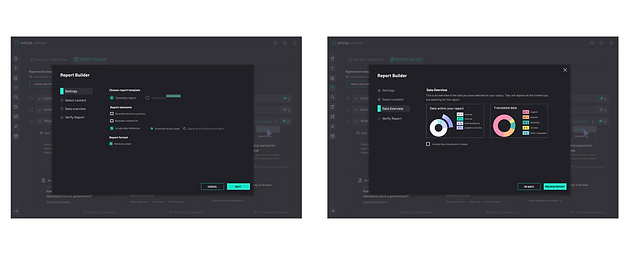
To address this, I designed an integrated reporting experience that treated output as a first-class product capability rather than an afterthought. The goal was not simply to generate reports, but to support analysts in crafting narratives they could stand behind, combining AI assistance with clear human control.
The reporting flow was designed to build directly on the workspace structure. Users could select which sections and insights to include, allowing the AI to draft a report that reflected the way the analysis had already been organised. Rather than presenting a single opaque output, the system exposed structure, summaries, and content in a way that invited review, refinement, and authorship. This ensured that the report felt intentional and accountable, not automatically produced.
HUMAN IN THE LOOP
A key design principle was keeping the human in the loop. In the environments Vantage operates in, trust is non-negotiable. I deliberately designed interactions that required user oversight at moments of synthesis, allowing analysts to adjust language, verify conclusions, and shape the final narrative. AI was used to accelerate structure and summarisation, but never to remove agency.
The final reports could be exported in familiar formats and shared externally, completing the journey from search to insight to deliverable output entirely within the product. This fundamentally changed how users perceived the platform. Vantage was no longer just a place to explore information, but a system that supported real decision-making and communication.

Redesigning the end to end workflow fundamentally changed how users engaged with Vantage and how value was delivered across the platform.
By connecting search, sense making, and reporting into a single flow, we significantly reduced the effort required to move from exploration to output. Analysts were able to produce structured insights and reports directly within the platform, rather than relying on external tools.
BUSINESS IMPACT
-
40–60% reduction in time spent moving from initial search to first report draft
-
Increased engagement with workspaces, with users capturing and organising insights earlier in their workflows
-
Improved trust in AI generated outputs, driven by clear human in the loop controls and transparent interactions
-
Stronger articulation of product value for internal teams, shifting the narrative from data access to decision support
LEARNINGS
This project reinforced the importance of designing for outcomes rather than features. Powerful AI capabilities only deliver value when they are embedded in workflows that reflect how people actually work.
It also highlighted the importance of trust in AI driven products. Keeping users in control, especially at moments of synthesis and reporting, proved essential for adoption and confidence.
Most importantly, it demonstrated that output is not a final step, but a core part of the product experience. Designing with that mindset fundamentally changed how we approached the platform.