OTHER PROJECTS

Building a geopolitical AI tool with custom agents
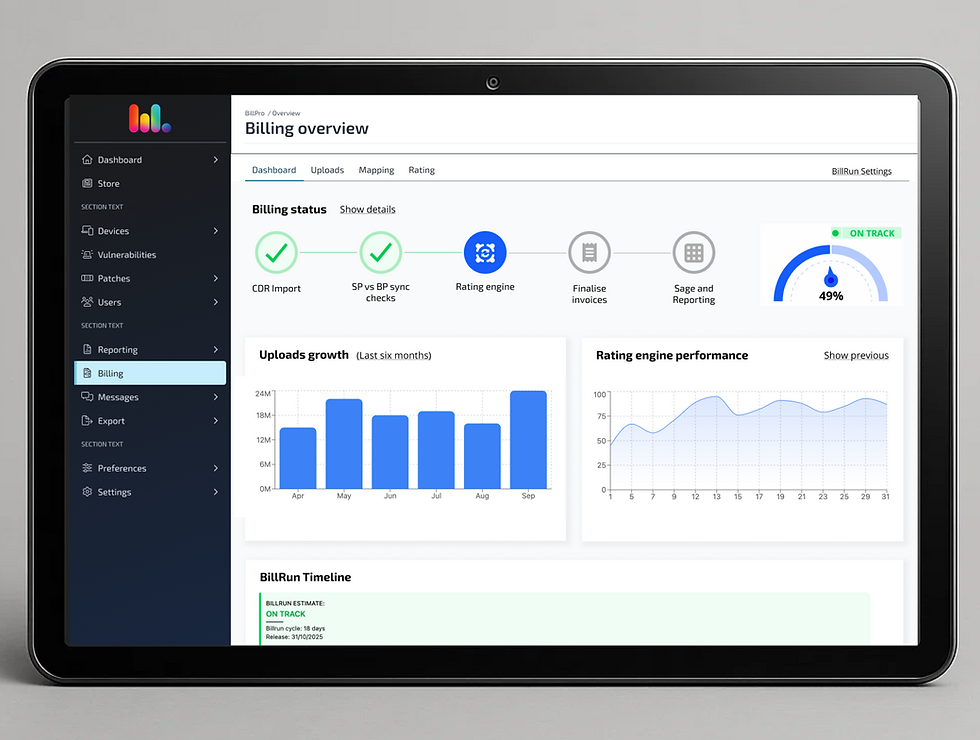
Turning billing complexity into a dynamic dashboard
•SERVICE DESIGN •BILLING OPERATIONS •FIGMA MAKE
Building a scalable billing
management service
INTRODUCTION
A core rate management capability within enterprise billing software. Designed to reduce operational risk, improve data confidence, and enable future billing models
Role
Product Designer
Timeline
August 2025 - January 2026
Tools
Figma,FigJam, FigmaMake, Lyssna

OVERVIEW
Wireless Logic operates in a highly complex billing environment where rate plans, tariffs, and billing rules are core to commercial operations. Historically, rate plan management relied on manual processes, spreadsheets, and specialist knowledge, creating risk, inefficiency, and limited scalability.
The Rate Plan Manager initiative set out to transform this landscape by designing an independent, scalable service that could manage the full lifecycle of rate plans while enabling downstream systems to consume reliable tariff data via APIs.
CHALLENGE
Rate plans sat at the intersection of commercial, billing, finance, and technology teams. Management of these plans relied heavily on manual processes, spreadsheets, and specialist knowledge built up over time. This led to slow turnaround times for rate changes, high operational risk, limited validation and auditability, and inconsistent terminology across teams. As a result, teams depended on a small number of experts to manage increasingly complex scenarios, creating fragility in day‑to‑day operations and increasing the risk of billing errors that could directly affect customers.
DISCOVERY
Discovery focused on understanding the current‑state workflows and pain points, mapping dependencies between teams and systems, identifying gaps in mental models and terminology, and surfacing risks, edge cases, and non‑obvious constraints that would shape any future solution.
ACTIVITIES
I conducted stakeholder interviews across commercial, billing, finance, and engineering teams, mapped end‑to‑end workflows for rate plan creation and change, and reviewed existing tools, spreadsheets, and documentation. Collaborative workshops were used to challenge assumptions and reframe problems using How Might We statements.
Discovery produced a set of foundational artefacts including process blueprints that exposed bottlenecks and manual handoffs, personas representing distinct internal user types, workflow maps highlighting risk points and dependencies, and How Might We statements that reframed operational pain points into clear design opportunities.


USER NEEDS
Synthesis revealed three core user needs. First, users needed confidence and trust in the data, supported by clear validation rules, transparency into how rates were calculated, and strong audit trails with approvals. Second, they required robust operational capability, including support for multiple billing models, safe change management, and clear lifecycle visibility. Finally, usability and efficiency mattered, with a need to reduce cognitive load through progressive disclosure and enable fast, repeatable workflows for common scenarios.
KEY INSIGHTS
-
Complexity is inherent, not optional .
The billing domain could not be simplified without introducing risk, making transparent complexity management more valuable than abstraction.
-
Trust precedes speed.
Users prioritised accuracy, validation, and auditability over efficiency, with speed only mattering once confidence was established.
-
Fragmented mental models.
Inconsistent terminology and understanding across teams created errors and misunderstandings, highlighting the need for a shared language.
-
Workarounds revealed real needs.
Unofficial spreadsheets and side processes exposed critical gaps, edge cases, and unmet system requirements.
.png)

OPPORTUNITY FRAMING
-
Prevent errors before they reach billing
Introduce strong validation and constraints to ensure only accurate, complete rate plans can be published.
-
Enable speed through safety
Allow faster rate changes by giving users confidence that changes will not break downstream systems.
-
Make complex rules understandable
Surface logic, dependencies, and impacts clearly so users can reason about configurations.
-
Design for future scalability
Ensure the system can support new billing models and commercial structures without fundamental redesign.
THE SOLUTION
The product vision was to establish Rate Plan Manager as an independent, central service rather than a feature within an existing system. It would be responsible for creating, validating, approving, and publishing rate plans while managing the full lifecycle of tariff data. By exposing trusted data to downstream systems via APIs, the service would act as a single source of truth and decouple commercial configuration from billing execution. This framing positioned Rate Plan Manager as foundational infrastructure, enabling long-term scalability and reducing systemic risk.
WIREFRAMING
Wireframing focused on translating complex domain logic into clear, predictable interaction patterns. I explored multiple structural approaches, including dashboard-led management views and dedicated creation and editing flows, to understand how users could navigate between oversight and detailed configuration. A clear separation was established between configuration, validation, and publishing to reinforce confidence and reduce accidental errors.
INTERACTIONS
Interaction design centred on complexity logic. Fields and inputs adapted dynamically based on the selected billing model, ensuring only relevant information was surfaced at any given time. Required and optional inputs were clearly differentiated, and constraints were surfaced inline to prevent invalid configurations early. The resulting patterns balanced flexibility with guardrails, allowing advanced scenarios without overwhelming users.


TESTING AND VALIDATION
Prototyping was used as a collaborative validation tool rather than a handoff artefact. I facilitated walkthrough sessions with key stakeholders to test terminology, logic, and workflow sequencing against real scenarios. These sessions helped surface edge cases, confirm assumptions, and align teams on how the system should behave in practice.
Validation resulted in early alignment on shared mental models and language, as well as the identification of technical and operational constraints that informed future delivery planning. Stakeholders gained confidence that the proposed interaction patterns could safely support both current and future billing needs.

BUSINESS IMPACT
-
45% reduction in billing-related errors – Upfront validation and clearer configuration rules significantly reduced the likelihood of incorrect rates reaching billing.
-
60% faster rate plan changes – Structured workflows and reduced specialist dependency shortened turnaround times for commercial updates.
-
85% reduction in manual operational effort – Eliminating spreadsheets, rework, and handoffs lowered day-to-day effort across commercial and billing teams.
-
Scalable foundation for future growth – A service-based architecture enabled new billing models to be introduced with minimal incremental cost or risk.
LEARNINGS
This work created a shared understanding of a highly complex problem space across commercial, billing, product, and engineering teams. By investing in deep discovery and validation, significant delivery risk was removed before build, and a scalable foundation for future billing evolution was established.
From a design perspective, the project demonstrates senior-level product design through navigating ambiguity, managing deep domain complexity, and balancing business risk with usability. The focus extended beyond screens to systems, services, and organisational alignment, showing how research-driven design can transform critical infrastructure into a confident, resilient product.